
Hiring a Roofer
How to Pick a Roofer (and Spot a Bad One)
Choose a roofer by verifying the business, insurance, relevant experience, written scope, and responsibility for the installation. Compare proposals, speak with past customers, and understand payment and warranty terms before signing. In Georgia, roofing-only specialty work generally does not require a state residential or general-contractor license, so a generic “licensed roofer” checklist is not enough. [B1]
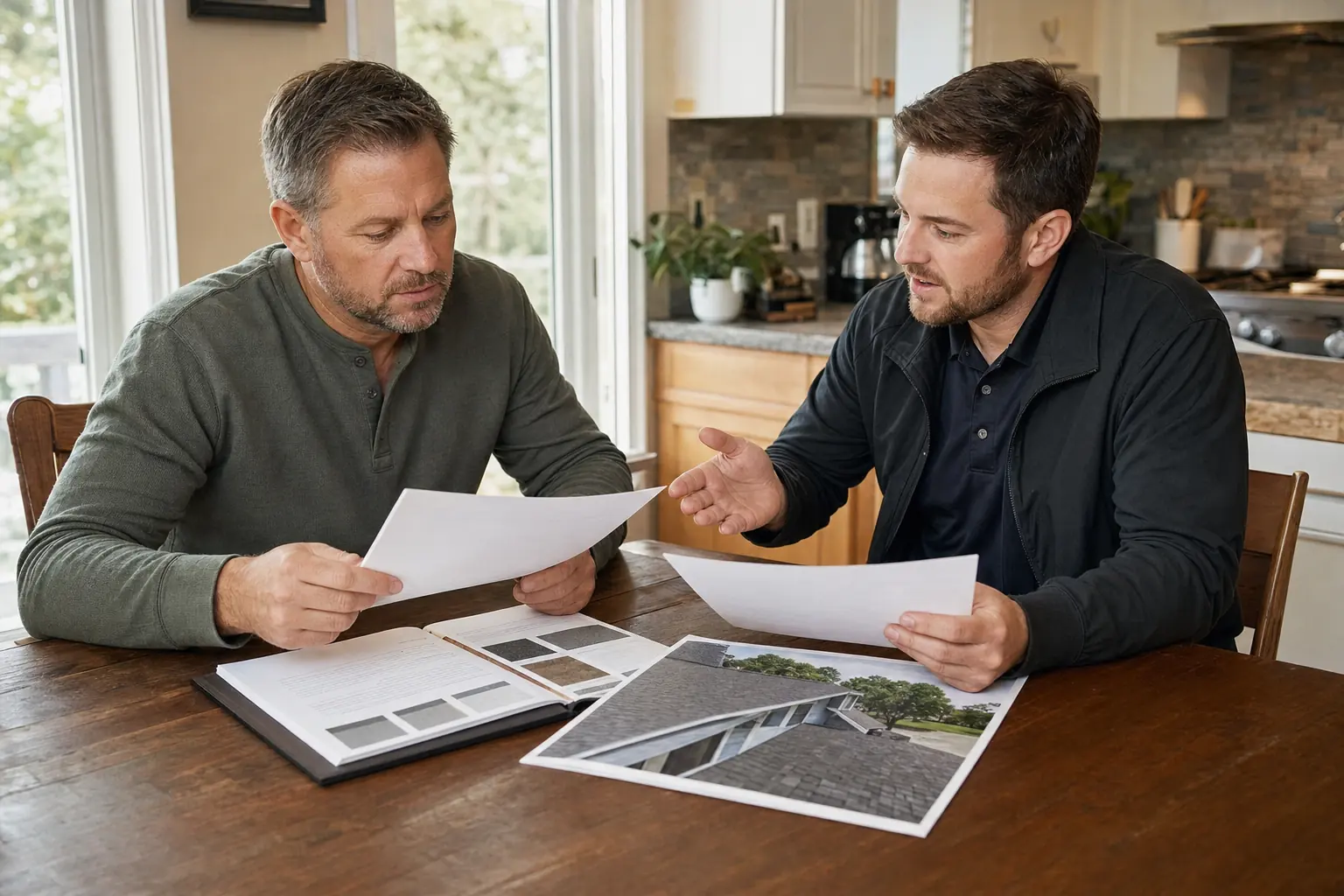
There are amazing people in the roofing business. I want to make that clear.
There are also people in construction who take advantage of homeowners. The challenge is that both can sound convincing at your kitchen table. A good salesperson can make almost anything sound like sunshine and rainbows.
You do not need to become a roofing expert to protect your decision. You need useful questions—and a willingness to verify the answers.
How can you tell a good roofer?
A good roofer should explain what your roof needs, what they propose, and who is responsible for the work.
Here is the evidence I would ask to see:
| Check | What to ask for |
|---|---|
| Company identity | The legal name on the contract, a reliable contact, and the applicable local business license |
| Insurance | Current liability and workers’ compensation information, with the named business and policy dates |
| Similar projects | References for roofs like yours, including someone whose installation is no longer brand-new |
| Scope | Materials, components, removal, repairs, and clearly stated exclusions |
| Crew | Who performs the installation and who supervises it |
| Accountability | Written workmanship terms and a process for service calls |
Georgia’s Consumer Ed recommends checking references, business documentation, insurance, and written warranties. Ask for evidence rather than accepting a sales pitch as verification. [B2]
What to verify
- Company identity
- Insurance
- Comparable scope
- Crew and supervision
- Payment milestones
- Written warranties
What does “licensed and insured” mean in Georgia?
There are different things people may mean by “licensed”: a local business license, a state contractor license, or sometimes a manufacturer credential that is not a government license at all.
The Georgia Secretary of State recognizes an exemption for specialty contractors working within their specialty. That does not remove applicable code requirements or authorize unrelated work requiring another license. If your project expands beyond roofing, verify what licenses the complete scope requires. [B1]
For local business licensing, check with the city or county. A company registration is not, by itself, proof of trade qualifications or insurance.
How do you verify insurance?
Ask the contractor to have its insurance agent provide current evidence of coverage. Confirm the business name matches the contracting party, ask whether the roofing work and people doing it are covered, and clarify who carries coverage for subcontractors.
Georgia’s State Board of Workers’ Compensation provides an online coverage-verification tool. Most employers with three or more employees must carry coverage, with rules affecting part-time staff and company officers. A claimed exemption should be checked rather than accepted as “we don’t need insurance.” [B3]
You are checking the actual arrangement for your project, not just whether an insurance logo appears on a website.
How do you tell if a roofer is lying?
Start by separating a claim you can verify from a promise you are expected to take on faith.
“We can beat everybody’s price.” Ask what is included and what assumptions make that price possible.
“You do not need to worry about your deductible.” Ask your insurer before agreeing. Georgia’s Attorney General warns that deductible-covering offers can involve false reporting and insurance fraud. Do not agree to conceal a discount or misstate the amount paid. [B4]
“There is no reason to check permits.” Ask the local building department. Requirements depend on the address and work, and the contract should identify who handles required permits and inspections. Georgia DCA explains the role of local enforcement. [B5]
“This roof has to be replaced immediately.” Ask for photos, the diagnosis, and an explanation of why a repair would not be appropriate. If there is no immediate safety issue, a second opinion can help you evaluate a major recommendation.
A low bid or a different professional opinion does not establish dishonesty. Evasive answers, changing explanations, or refusal to document important promises give you a reason to pause.
How do you tell if a roofer is scamming you?
The FTC identifies pressure to decide immediately, demands for full payment before work, cash-only arrangements, and blank or unread documents as warning signs. Its advice is to compare estimates and read the agreement before committing. [B6]
I would be especially concerned if the contractor cannot explain who you are hiring, what the work includes, or how to reach the company after installation.
You can authorize a clearly defined temporary repair without rushing into an entire roof replacement. The documents should say which service you are buying.
What payment schedule should you use?
A deposit is not automatically a problem. The question is how much you are paying, what triggers each payment, and what the agreement says if the project changes.
One structure I like discussing is:
| Payment | Clearly defined milestone |
|---|---|
| 33% | Materials delivered as agreed |
| 33% | Installation completed as agreed |
| 34% | Final walkthrough, agreed corrections, warranties, and required paperwork complete |
This is my suggested structure, not a Georgia legal requirement or a payment policy for every RoofNuts contractor. Specify the milestones in the contract; “almost finished” is not a useful payment trigger.
Georgia’s Attorney General suggests considering an initial payment of no more than one-third, with later payments linked to completed work and the final payment after completion. [B4]
A request for 55% upfront does not prove a scam. It does call for a clear explanation of the materials, timing, cancellation terms, and protections involved. Ask for receipts and keep a copy of the signed agreement.
Are there special rules for disaster-related contracts?
Yes. Georgia’s Attorney General explains protections under SB 201 for qualifying home-repair contracts entered within a year of a natural disaster. These include restrictions on assigning insurance proceeds and cancellation rights following an insurer’s notice that all or part of the loss is not covered. The described cancellation period is five business days after that notice. Review the official guidance and your contract for the exact conditions. [B4]
Those protections are not a universal five-day cancellation rule for every roofing contract. If a dispute or cancellation deadline is involved, get advice promptly about your specific agreement.
How do you spot a bad roofing company?
Do not stop at the star rating.
Reviews can help, but they do not tell you everything about how a company manages work or who will install your roof. I think about two responsibilities:
The company: Can it organize the project, communicate, and stand behind the agreement?
The installation crew: Does it have experience with the proposed system, and who checks the work?
Subcontracting alone is not proof of good or bad quality. Ask who is responsible for the crew, what supervision looks like, and who corrects a problem.
When checking references, go beyond “Were they nice?” Ask:
- Did the final scope match the proposal?
- How were unexpected repairs and extra charges handled?
- Was the property protected and cleaned up?
- Have you needed a service call, and how did the company respond?
In my evaluation process, local supply houses and people familiar with installation crews can add useful context. That does not replace checking documents or hearing from actual customers.
If the estimate itself is confusing, our new roof cost guide for Georgia explains how to compare quantities and scope before comparing totals.
More questions before hiring a roofer
Should I always choose the lowest roofing estimate?
No. Ask whether the estimates cover the same work and whether you are comfortable with the contractor’s evidence, responsibilities, and terms. A higher number also needs justification. The goal is an appropriate roof system from an accountable company at a price you understand.
Are manufacturer certifications a guarantee of good work?
Treat a claimed credential as something to verify directly with the manufacturer. Ask which system and warranty it applies to. It does not replace reviewing the actual scope, supervision, and workmanship agreement for your project.
What if I think I have already been scammed?
Keep the contract, payment records, messages, and photographs. Georgia’s Attorney General accepts consumer complaints through its Consumer Protection Division; suspected insurance fraud can also be reported to the state insurance office. Use the official contact links rather than numbers provided by someone offering to recover your money. [B7]
You stay in control
RoofNuts helps homeowners ask better questions, understand proposed roof systems, and compare contractor options. Our consultation is intended to help identify three qualified contractors suited to your project.
Our Process explains how that consultation works. Ask about the selection process and any applicable fees or contractor relationships before proceeding.
You pick the contractor. We help you make an informed choice.
Sources
- B1: Georgia Secretary of State, Traditional Specialty Contractors Policy Statements.
- B2: Georgia Consumer Ed, How do I know if a roofer is reputable or not?, February 4, 2025.
- B3: Georgia State Board of Workers’ Compensation, Coverage Verification.
- B4: Georgia Attorney General, Storms and Fraud.
- B5: Georgia DCA, Administration and Enforcement of State Minimum Codes.
- B6: FTC, How To Avoid a Home Improvement Scam.
- B7: Georgia Attorney General, Consumer Alert on Winter Storm Scams, January 23, 2026; includes official reporting contacts.
Sources checked October 8, 2026. Jay’s evaluation preferences and payment example are guidance, not legal requirements. Licensing, insurance, and contract questions depend on the actual project and agreement.